
If you’re researching infant daycare in Tauranga or anywhere in New Zealand, you’ll see the term “ratio” everywhere — and almost no centre explains what it actually means for your baby’s day. This is the post we wish we could just send to every parent on a centre tour.
The legal minimum: 1 to 5 for under-2s
The Education (Early Childhood Services) Regulations 2008 set the minimum adult-to-child ratio in a teacher-led centre at 1 adult to 5 children under 2 years old. That’s the floor. A centre cannot legally operate below it.
A few important nuances:
- The “1 adult” doesn’t have to be a qualified teacher. It can be any responsible adult counted in the regulated ratio. The separate rule about qualified staff is that at least 50% of teachers in a teacher-led service must be ECE-qualified and registered.
- The ratio applies at all times — including during nappy changes, sleep, and lunch. Centres need enough staff on shift to cover breaks without dropping below 1:5.
- For 2-year-olds (between their second and third birthday), the minimum changes to 1:6 in licensed centres, or 1:10 if the centre is operating under a “mixed” license that includes over-2s.
So when someone says “we meet ratios” — that’s the legal minimum. It’s not a quality signal.
Why 1:5 is being challenged
The minimum ratio for under-2s has been under pressure for years. Te Rito Maioha and other ECE bodies have publicly campaigned for 1:4 for under-3s, citing research that shows responsive caregiving — the back-and-forth that builds language and attachment — drops off measurably when a single adult is responsible for five non-mobile or just-mobile babies.
The petition and submission work in 2024–2025 surfaced what many parents already sensed: at 1:5, a teacher feeding one baby a bottle while supervising two on a play mat, with two more about to wake from naps, simply can’t give each child the eye contact, narration, and gentle handling that the early months need.
Most quality NZ centres now operate better than the legal minimum — often 1:4 or 1:3 in the babies room — and price that into their fees. If a centre advertises “low ratios,” ask the actual number.
What ratios actually look like in practice
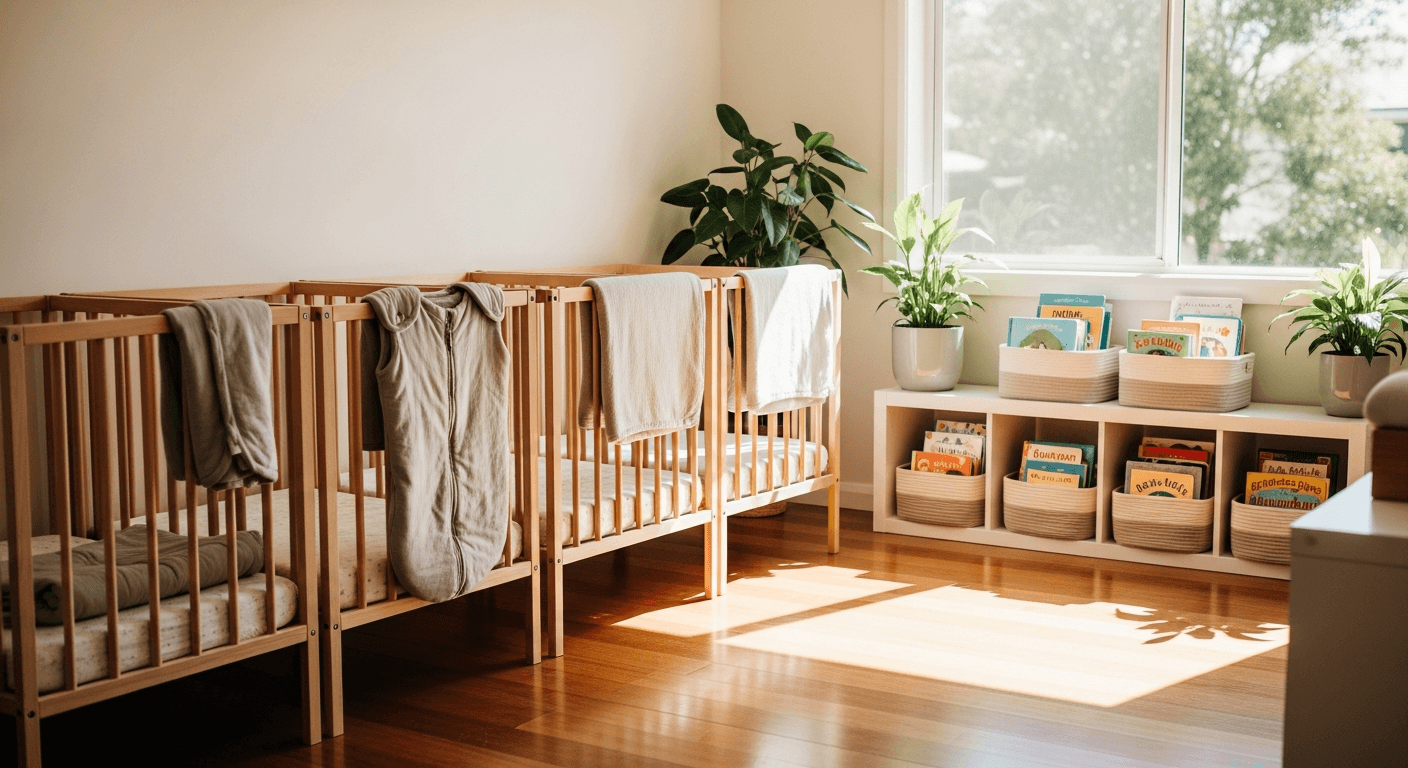
Numbers on a page don’t tell you what your baby’s day feels like. A 1:4 ratio in a calm, well-laid-out babies room with two cots, a dedicated change space, and consistent staff is very different from 1:4 in a noisy mixed room with three teachers passing children between them.
When you tour, watch for:
- Where the teachers are physically positioned. In a good babies room, one teacher is usually on the floor at child level, not standing at the edge.
- How often the same teacher returns to the same baby. This is the “primary caregiver” model in practice. If your baby is handed to a different person every transition, the ratio number doesn’t matter much.
- What happens during a nappy change. The teacher changing a nappy is technically still “in ratio” because the baby is in their direct care — but they can’t actively engage the other four. Centres with good ratios design the room so other teachers naturally cover during transitions.
- What happens at sleep time. A baby asleep in a cot still counts toward ratio. Sleep is a quiet time when a teacher can do focused 1:1 work with awake babies — but only if the room has the space and routine for it.
The questions worth asking on a tour
Not “what’s your ratio?” — every centre will answer 1:5 or “better.” Instead:
- “How many under-2s are in the room on a typical Wednesday?” Wednesdays are the busiest day in most centres. This tells you actual headcount, not licensed capacity.
- “How many of those teachers are ECE-qualified?” The 50% rule is the legal floor. Quality centres run higher.
- “Who would be my baby’s primary caregiver?” If the answer is “the whole team,” that’s a red flag for under-1s.
- “What’s your teacher turnover been in the last year?” Continuity matters more for babies than for any other age. A great 1:4 ratio with three new teachers in six months is worse than a steady 1:5.
- “Can I see the babies room when it’s full?” Some centres only show you the room mid-morning when half the babies are asleep. Ask to visit at 10:30 or 3:00 when it’s at capacity.
A note on home-based care
If you’re also looking at home-based educators (e.g. PORSE, Kids at Home, Au Pair Link), the ratio rules are different. A home-based educator can have a maximum of four children under 5, with no more than two under 2. That’s effectively a 1:2 ratio for under-2s in a home setting — tighter than any centre — though without the qualified-teacher floor.
The trade-off is centre infrastructure vs home-based intimacy. Both can work well. Ratio is one factor.
What ratios mean for fees
Better ratios cost more. A centre running 1:4 in the babies room needs 25% more staff than one running 1:5, and that flows through to weekly fees for under-2s. If a Tauranga centre is meaningfully cheaper than the others, the ratio is often where the savings come from. It’s a fair trade-off to think about, but worth knowing rather than assuming the price is just market positioning.
Frequently asked questions
What is the legal teacher-to-child ratio for under-2s in New Zealand? 1 adult to 5 children under 2 years old in a licensed teacher-led centre, set by the Education (Early Childhood Services) Regulations 2008.
Do all the adults in the ratio have to be qualified teachers? No. At least 50% of teachers in a teacher-led service must be ECE-qualified and registered. The remaining 50% can be unqualified adults counted in the ratio.
Is 1:5 considered a good ratio for babies? It’s the legal minimum, not a quality benchmark. Many ECE leaders and unions have argued for 1:4 or 1:3 for under-2s. Most quality centres run better than the legal minimum.
What is the ratio for home-based childcare? A home-based educator can have a maximum of 4 children under 5, with no more than 2 under 2 — effectively 1:2 for under-2s.
Does the ratio change during nappy changes or sleep? No — the legal ratio applies at all times. Centres need enough staff scheduled to maintain ratio during transitions, breaks, and sleep periods.
Our infant daycare in Welcome Bay operates with ratios better than the legal minimum and a primary caregiver model. Book a tour and ask us the five questions above — we’ll answer all of them honestly.