
Going back to work while breastfeeding is doable. Sending expressed milk to daycare without losing your mind is also doable — but it takes a system. This guide covers what NZ centres are required to do, how much milk to send, how to store and label it, and the practical realities of pumping at work in Tauranga.
What NZ daycares are required to do with breastmilk
Licensed NZ early childhood centres operate under the Food Act 2014 (for food-handling generally) and the Education (Early Childhood Services) Regulations 2008. For breastmilk specifically:
- Milk must be labelled with baby’s name and the date and time it was expressed.
- Milk must be stored in the fridge at 4°C or below, or in a freezer if frozen.
- Once warmed, milk must be used within 1 hour and unused portions discarded.
- Bottles must be cleaned and sterilised to standard food-handling protocols. Most centres do this in-house but expect parents to supply their own bottles.
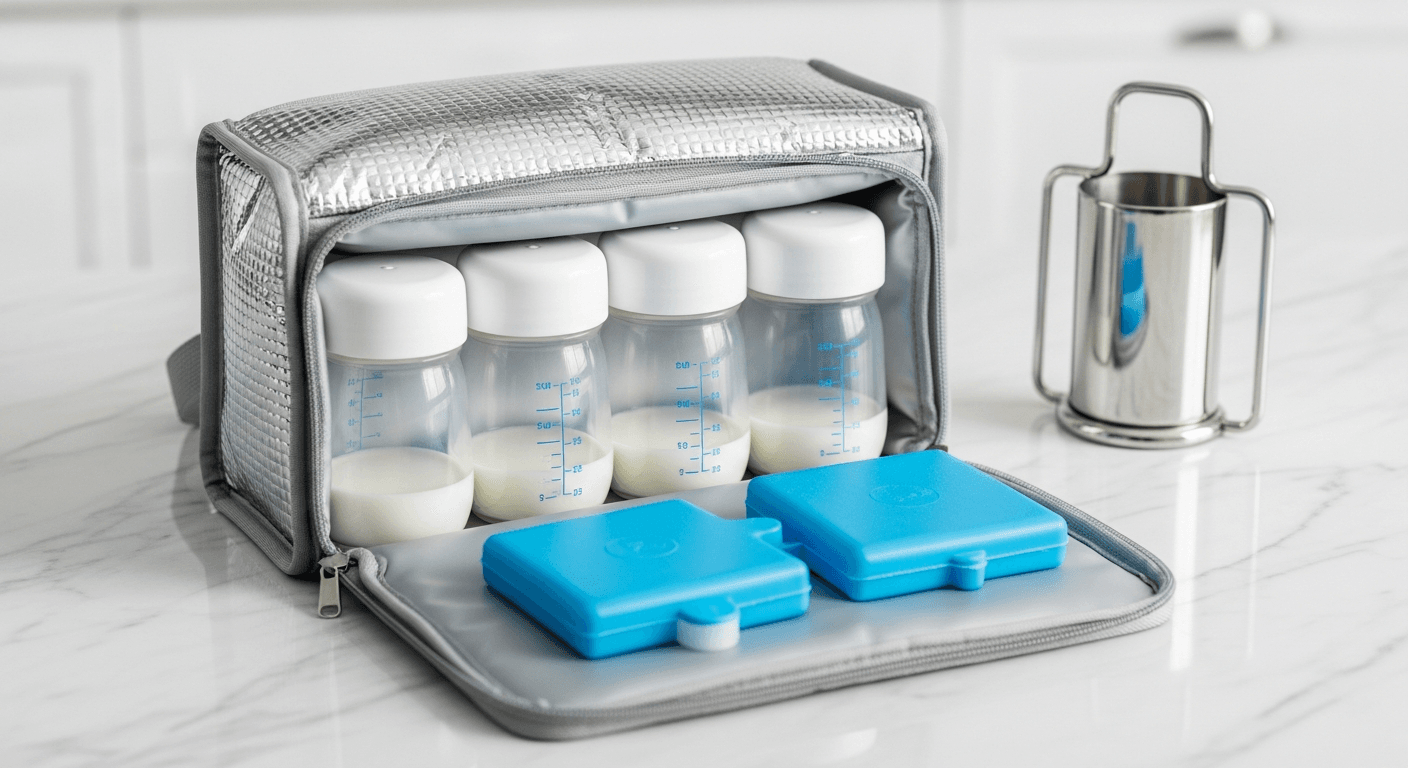
- Many centres ask parents to provide a separate cooler bag for transporting milk in summer, especially in Tauranga’s warmer months.
If a centre seems vague on milk storage, ask to see their kitchen and where milk is stored. A clean labelled bottle in a clearly labelled fridge tray is a good sign.
How much milk to send each day
A common starting estimate:
- Newborn–3 months: 60–90 ml per feed, every 2–3 hours = ~600–900 ml per 8-hour day
- 3–6 months: 90–120 ml per feed, every 3 hours = ~450–600 ml per 8-hour day
- 6–9 months (solids introduced): 60–120 ml per feed, 3 feeds = ~300–400 ml per day
- 9–12 months: 60–90 ml per feed, 2–3 feeds = ~150–300 ml per day
These are averages. Babies are not averages. Send a bit more than you think you’ll need in the first week (centres often request a “buffer” feed for late pickups), then dial it in based on what comes home unused.
Pack each feed in a separate bottle rather than one big container. This prevents waste — once warmed, a partial bottle has to be discarded, so smaller bottles save milk.
Labelling — the food-safety basics
Every bottle needs:
- Baby’s first and last name
- Date expressed
- Time expressed
- Volume (helpful but not always required)
A waterproof name label or a dishwasher-safe sticker works. Tape and Sharpie work too — they just need to survive a dishwasher cycle.
Some centres provide standard label stickers in the enrolment pack. Use them — it makes the kitchen team’s job easier and reduces mix-ups.
Fresh vs frozen — what to send when
Fresh expressed milk (within 4 days of expressing) is the default for daily daycare use. Most parents pump the night before or that morning, store overnight in the fridge, and pack into the bag at drop-off in a cooler with an ice pack.
Frozen milk is for backup. Most parents keep a freezer stash for:
- Days when pumping at work went badly
- Late finishes when baby needs an unexpected feed
- The transition month when supply is settling
NZ daycares will accept frozen milk but want it labelled with the expressed date, and they’ll usually defrost in the fridge overnight (not in warm water) for use the next day. Don’t expect a centre to defrost from frozen on demand.
Paced bottle feeding — the conversation to have
If you’re breastfeeding, you probably want your baby’s bottle feeds at daycare to mimic breastfeeding rhythm — slow, paced, with breaks. This is called paced bottle feeding, and many NZ early childhood teachers are trained in it.
Worth asking on the tour:
- “Do your teachers use paced bottle feeding for breastfed babies?”
- “What teat flow do you typically use?” (Slow flow is best for breastfed babies — usually size 1 or “newborn” throughout the first year.)
- “Can my baby be held during bottle feeds rather than propped?” (Yes is the only acceptable answer for under-1s.)
If a centre defaults to fast-flow teats and propped bottles, breastfed babies often start refusing the breast at home. Worth catching early.
Pumping at work — your rights and the practical bit
In New Zealand, employers must provide reasonable breaks and a suitable space for breastfeeding or expressing milk when you return to work, under the Employment Relations Amendment Act (Breaks and Infant Feeding) 2008. “Suitable” means:
- Private (not the bathroom)
- A space where you can sit comfortably
- Access to a fridge for storage
In practice, the rights are clear but the implementation is sometimes awkward. Worth doing before you return:
- Tell HR or your manager in writing what you’ll need (a private room, a fridge, two 15-minute breaks)
- Walk through the space ahead of your return so you’re not improvising on day one
- Buy or borrow a double electric pump — manual pumps take too long to fit into a work day
- Bring spare parts to work so a forgotten valve isn’t a missed session
Most parents pump 2–3 times during an 8-hour day in the first few months back, dropping to 1–2 times as baby gets older or starts solids.
What to do when your supply dips
It’s almost universal: supply drops a bit in the first month back at work. Stress, less skin-to-skin contact, and the mechanical difference between baby and pump all play a role. Practical responses:
- Add a pump session. One extra short session (10 minutes) in the late evening or early morning can recover the equivalent of 60–90 ml within a week.
- Feed on demand on weekends. Two full days of demand-feeding rebuilds supply faster than any other intervention.
- Use freezer stash to bridge. That’s what it’s for.
- Talk to a lactation consultant if dips persist beyond a few weeks. Tauranga has several IBCLC-qualified consultants who do home visits.
A note on combination feeding
Many parents combine breastmilk and formula at daycare. This is fine and often more sustainable long-term than aiming for exclusive breastmilk through to 12 months. If you’re combining:
- Use separate bottles for breastmilk and formula (don’t mix in the same bottle for storage).
- Send formula pre-measured in a sealed container with a labelled water bottle — most centres won’t keep tins of formula on site.
- Tell the centre your preferred sequence (e.g. breastmilk first, formula if more is needed).
Frequently asked questions
How do I store breastmilk at daycare? NZ centres store breastmilk in the fridge at 4°C or below, in clearly labelled bottles. Frozen milk is stored in the freezer and defrosted in the fridge before use.
How much expressed milk should I send to daycare each day? For a 3-6 month old in care 8 hours, around 450–600 ml across 4–5 separate bottles. Adjust based on what comes home unused.
Can my baby get paced bottle feeding at daycare? Most NZ early childhood teachers are trained in paced bottle feeding. Ask specifically on the tour, especially if you want to protect breastfeeding at home.
What if I can’t pump enough at work? A short freezer stash bridges most short-term dips. Adding one extra pump session and demand-feeding on weekends usually recovers supply within a week. A lactation consultant can help if it persists.
Do I have a legal right to pump at work in NZ? Yes. Under the Employment Relations Amendment Act (Breaks and Infant Feeding) 2008, employers must provide reasonable breaks and a suitable private space for breastfeeding or expressing milk.
Our babies centre in Welcome Bay supports breastfeeding parents with paced bottle feeding, proper milk storage, and flexibility for parents who want to come back for a lunchtime feed in the early weeks. Talk to us about your feeding plan.